About GCI

About Canada - Highlights
Study in Canada for Indian students is one of the best options in 2026, if you want quality education, global exposure, and better career opportunities. Canada offers top-ranked universities and affordable tuition compared to the USA and UK. Also, you will get strong job prospects after graduation.
Many Indian students choose Canada because of its safe environment, multicultural society, and clear pathway to work and PR. It is an open secret that most Indian students choose to study abroad to get a chance to settle there.
If you plan to study in Canada in 2026, you need to understand key things like eligibility, total cost, visa process, scholarships, and job opportunities. Most Indian students spend around INR 16 to INR 35 lakh per year, including tuition and living expenses. You can also work part-time in Canada during studies and apply for a post-study work permit after graduation.
This guide will help you understand everything in a simple way. From choosing the right course to getting a Canadian student visa. It is designed especially for Indian students planning for the 2026 intake.
Latest Updates About Studying in Canada (2026)
Staying updated on the latest Canada study policy updates is important for a successful application. IRCC has introduced several major changes to manage student volumes and ensure students are financially prepared.
Policy Feature Update Details (2026) GIC Amount Increased to $20,635 CAD (for 2024/2025) and up to CAD 22,895. Study Permit Cap National limit set for 2026 at 408,000 permits (a 7% decrease from 2025). PAL Requirement Most undergraduate/college students need a Provincial Attestation Letter (PAL). PGWP Changes New field of study and language (CLB 7/5) requirements for many graduates. Spouse Work Permit Now restricted mainly to partners of Master’s and Doctoral students.
PAL Requirement Explained
- Who needs it: Most undergraduate and professional program applicants must include a Provincial Attestation Letter (PAL) with their study permit.
- Who is exempt: As of January 1, 2026, Master’s and Doctoral students at public institutions do not need a PAL.
Updated GIC Amount
- New Requirement: To cover living costs, the GIC amount has increased to CAD 22,895 for the 2026 intake.
- Total Funds: You must show this amount plus your first-year tuition fees to prove financial stability.
Study Permit Cap Impact
- Limited Spots: IRCC has set a national cap of 408,000 permits for 2026.
- Pro Tip: Apply as early as possible. Competition is higher for college and undergraduate spots due to these limits.
PGWP Eligibility Changes
- In-Demand Fields: Post-Graduation Work Permits are now linked to labour market needs (e.g., Healthcare, STEM, Trades).
- Language Rules: You must meet new English standards: CLB 7 for University graduates and CLB 5 for College graduates.
Spouse Work Permit Rules
- Eligibility Change: Open work permits for spouses are now restricted.
- Current Rule: Your partner is generally only eligible if you are enrolled in a Master’s or PhD program lasting at least 16 months.
Why Study in Canada in 2026?
Many students choose to study in Canada for Indian students because it offers quality education, better job opportunities, and a clear pathway to settle after studies. In 2026, Canada remains one of the most practical options for Indian students planning to study abroad. Some of the benefits of studying in Canada for international students include:
- Quality Education: Canada has top-ranked universities like the University of Toronto and McGill University. Degrees are globally accepted, and courses focus on practical skills and job readiness.
- Affordable Compared to USA and UK: The cost to study in Canada is lower than the USA and UK. Tuition fees usually range between INR 10 and 25 lakh per year, making it a more affordable option for Indian students.
- Work While Studying: International students can work up to 24 hours per week during academic sessions and full-time during scheduled breaks. This helps cover living expenses and gain work experience.
- Post-Study Work and PR Opportunities: Canada offers a Post-Graduation Work Permit (PGWP) of up to 3 years. Students can gain work experience and apply for PR through programs like Express Entry.
- Safe and Student-Friendly Environment: Canada is known for its safety, clean cities, and multicultural environment. It has a large Indian community, which makes it easier for students to adjust.
Quick Student Checklist for 2026
Feature Details Work Hours Up to 24 hours/week during study and full-time during breaks Tuition Fees INR 10 to 25 lakh per year (average) PGWP Up to 3 years after graduation (based on program) PR Pathway Possible through Express Entry after work experience Safety One of the safest countries for Indian students
Top Universities in Canada for Indian Students (2026)
There are multiple universities in Canada which are reputed. For the 2026 intake, Canadian universities continue to dominate global rankings. They offer high research impact and excellent employer reputations.
Below are the top-ranked institutions based on the QS World University Rankings 2026.
Top 10 Canadian Universities: Rankings & Fees
Best Universities in Canada
QS World University Ranking 2026
THE Ranking 2026
27
41
University of Toronto
29
21
University of British Columbia
40
45
University of Alberta
94
119
University of Waterloo
119
162
Western University
151
201-250
168
150
McMaster University
173
=116
Queen's University
191
301-350
University of Calgary
211
200
What Makes These Universities Special?
- High Employability: Universities like Waterloo and Toronto have strong ties with global tech giants like Google, Amazon, etc.
- Co-op Programs: Most top universities in Canada offer "Co-op" options. It allows you to gain paid work experience while studying.
- Scholarship Availability: These institutions offer millions in entrance scholarships specifically for high-achieving international students.
Admission Requirements to Study in Canada
The eligibility requirements to study in Canada will vary from course to course and from university to university. For admission to undergraduate courses, students need to have a high school diploma or equivalent degree and proof of English proficiency. For instance, for MS studies, you need to present a GRE score.
Some of the basic eligibility requirements are given below.
- Academic transcripts
- Standardized test scores - SAT
- Standardized test scores - GMAT / GRE / LSAT
- English language proficiency test scores: TOEFL / IELTS / PTE / Duolingo / CAEL
- Statement of Purpose
- Essay
- Provincial Attestation Letter (PAL)
- Letter of Recommendation
- Copy of your valid passport
- Proof of finances (Guaranteed Investment Certificate)
Documents Required to Study in Canada
Here is the list of documents required for pursuing higher studies in Canadian universities:
- Academic Transcripts
- Proof of English Proficiency
- Statement of Purpose (SOP)
- Letters of Recommendation
- Resume or CV
- GMAT or GRE Scores (If Applicable)
- Valid Passport
- Letter of Acceptance from University
- Proof of Funds
- Medical Report of Student
- Police Clearance Certificate
- Recent Photographs of Student
What is Cost of Studying in Canada for Indians (2026)
Planning your finances is most important step for Indian students. Canada is generally more affordable than the US or UK but more expensive than India. Recent policy changes have increased the required "proof of funds" to better reflect the modern cost of living in Canada.
For the 2026 academic year, Indian students should budget between INR 18 Lakhs and INR 35 Lakhs per year, depending on their course and city.
Estimated Annual Expenses (2026)
Expense Category Annual Cost (CAD) Annual Cost (INR Approx.) Tuition Fees (UG/Diploma) CAD 15,000 to CAD 45,000 INR 9.4L to INR 28L Tuition Fees (Master’s/MBA) CAD 20,000 to CAD 60,000 INR 12.5L to INR 37.5L Living Expenses (GIC Requirement) CAD 22,895 INR 14.3 Lakhs Health Insurance CAD 600 to CAD 1,000 INR 38,000 to INR 63,000 Miscellaneous (Books & Supplies) CAD 1,000 to CAD 2,000 INR 63,000 to INR 1.2L Visa & Biometrics Fees CAD 235 INR 15,000
Note: 1 CAD ≈ INR 62.50. Living costs in cities like Toronto or Vancouver may exceed the government minimum (CAD 22,895).
The cost of studying in Canada entirely depends on the course, university, duration of the course, and the cost of living. Have a look at the big expenses that you need to cover:
- Tuition Fees: This is your largest expense. Professional courses like MBA, Data Science, and Engineering are at the higher end, while Humanities and Education are more affordable.
- The New GIC Rule: To get your Canada student visa, you must now deposit CAD 22,895 into a GIC account. This money is paid back to you in monthly installments to cover your rent and food.
- Health Insurance: It is mandatory. In provinces like Ontario, this is often billed directly by your university as UHIP (approx. CAD 750/year).
- Work Off-Campus: In 2026, students can work 24 hours per week. At an average wage of CAD 16/hour, you can earn roughly CAD 1,500+ per month, which can cover most of your groceries and transit.
Scholarships in Canada for Indian Students (2026)
Securing a scholarship is a fantastic way for Indian students to offset the cost of studying in Canada. Most scholarships for the 2026 intake are merit-based, though some also consider financial need and leadership potential.
In order to avail of the scholarships to study in Canada, students need to have a track record of good academics and extra-curricular achievements. Need-based scholarships are also available for students. Some of the Canadian scholarships for Indian students are given below:
Top Scholarships for Indian Students (2026 Intake)
Scholarship Name Scholarship Type Benefit Lester B. Pearson International Undergraduate (U of Toronto) Full Ride: Tuition, books, residence, and living costs for 4 years. Vanier Canada Graduate PhD / Doctoral CAD 50,000 per year for 3 years. Ontario Graduate Scholarship (OGS) Master’s / PhD (Ontario) CAD 15,000 per year. UBC International Scholars Undergraduate (UBC) Up to Full Tuition & Living (Need-based). University of Calgary Entrance Undergraduate CAD 20,000 (Renewable). Waterloo International Entrance Undergraduate CAD 10,000. Ontario Trillium Scholarship PhD (Ontario) CAD 40,000 per year for up to 4 years.
Here are some fully funded scholarships in Canada that can cover your 100% tuition fee and other expenses. Condition is that you need to be eligible for this:
- Lester B. Pearson International Scholarship (University of Toronto)
- Vanier CGS Scholarship
- UBC International Scholars Program
- Pierre Elliott Trudeau Foundation Scholarship
- University of Manitoba Graduate Fellowships (UMGF)
Education Loan for Studying in Canada
Canada is the most preferred destination to study abroad by international students. Not everyone has the big pockets to afford to study and live in Canada. This is why various banks and financial institutions offer education loans to students who want to study in Canada.
Before applying for an educational loan to study in Canada, check the eligibility criteria in advance in order to get the loan approval. Note that different types of expenses are covered under different schemes, so check with the banks to know what expenses are covered in the education loan scheme. Some of the expenses covered under the educational loan are:
- Tuition fees
- Travel expenses
- Cost of buying books and other study material
- Hostel fee
- Laboratory fee
- Purchase of a laptop
- Expenses for study tours or project tours.
Canada Student Visa Process (Step-by-Step)
The visa process has changed significantly for the 2026 intake. Following the discontinuation of the SDS stream in late 2024, all Indian students now apply through the Standard Stream, which requires more detailed financial documentation.
- Get Admission: Apply to a Designated Learning Institution (DLI).
- Receive LOA & PAL: Get your Letter of Acceptance. Most students also need a Provincial Attestation Letter (PAL) from their university.
- Pay GIC: Deposit CAD 22,895 into a Canadian bank to cover living costs.
- Apply for Visa: Submit your study permit application online via the IRCC portal.
- Biometrics & Medicals: Visit a VFS centre for fingerprints and complete a medical exam.
- Approval: Receive your Passport Request (PPR) and Letter of Introduction.
Just remember few things before applying for Canadian student visa:
- Processing Time: Currently 8 to 12 weeks. Plan to apply at least 4 months before your course starts.
- Success Tip: Write a detailed Statement of Purpose (SOP). Since the fast-track stream is gone, officers now look closely at your "genuine intent" to study an
Part-time Work in Canada 2026
On the Canadian student visa, students can work for 24 hours/week on a paid job, while studying. Generally, for part-time jobs in Canada, students are paid by hours. On average, the rate of pay is around $13-16 an hour.
However, recently, international students who are in Canada and who have off-campus work authorization on their study permit shall not be restricted by the rule of 24 hours per week. Generally, students can work full-time during school breaks.
Work While Studying Rules in Canada (2026)
Indian students in Canada can work part-time during studies and full-time during scheduled breaks. Only if they have a valid study permit and are enrolled in a Designated Learning Institution (DLI).
Key rules (2026):
- Up to 24 hours per week off-campus during academic sessions (IRCC updated limit from previous 20 hours).
- Full-time work allowed during scheduled breaks (summer, winter holidays).
- No separate work permit required for off-campus work.
- You must be enrolled in a full-time program lasting at least 6 months.
- You need a Social Insurance Number (SIN) to work legally.
- On-campus jobs usually don’t have hourly limits.
Working while studying helps cover living expenses, gain Canadian work experience, and improve PR chances later through programs like PGWP and Express Entry.
Tip: Most students earn CAD 12 to 18 per hour in part-time jobs.
Post-Study Work Permit in Canada
The Post-Graduation Work Permit (PGWP) allows international students to work in Canada after graduation. PGWP duration depends on your course length and institution type.
The duration and validity of your Post-Graduation Work Permit (PGWP) depend entirely on the length of your academic program and the tier of your educational institution:
Program Type Course Duration PGWP Duration Important Rule Master’s Degree 8 months or more Up to 3 years Available for eligible public university programs Doctoral (PhD) Programs 8 months or more Up to 3 years Students can get a 3-year PGWP Undergraduate Degree 4 years Up to 3 years Students must maintain full-time enrollment College Diploma Less than 2 years Equal to study duration Example: 1-year diploma = 1-year PGWP College Certificate Less than 2 years Equal to course duration Field must match NOC shortage occupations
Key Points About PGWP in Canada
- Master’s and PhD students may get a 3-year PGWP.
- Bachelor’s graduates can get up to 3 years of work rights.
- College programs have stricter PGWP rules.
- Course eligibility depends on institution and field of study.
Top Cities Preferred by Students in Canada
Canada is home to some of the top-ranked universities in the world as per many global ranking providers. These universities are located in some of the popular cities like Toronto, Montreal, Ottawa, etc. Many big and small cities are there for students to study in Canada.
Check the QS best student cities in Canada 2026 for international students from the table given below:
Student Cities in Canada
QS Best Student Cities Ranking 2026
Montreal
#18
Toronto
#22
Vancouver
#29
Ottawa
#80
In addition, these cities offer a lifestyle similar to that of the U.S. and provide employment opportunities to students. Other than this, calgary and Saskatoon are some of popular student cities in Canada.
Shiksha Poll: Which Canadian City is the Best for Study?
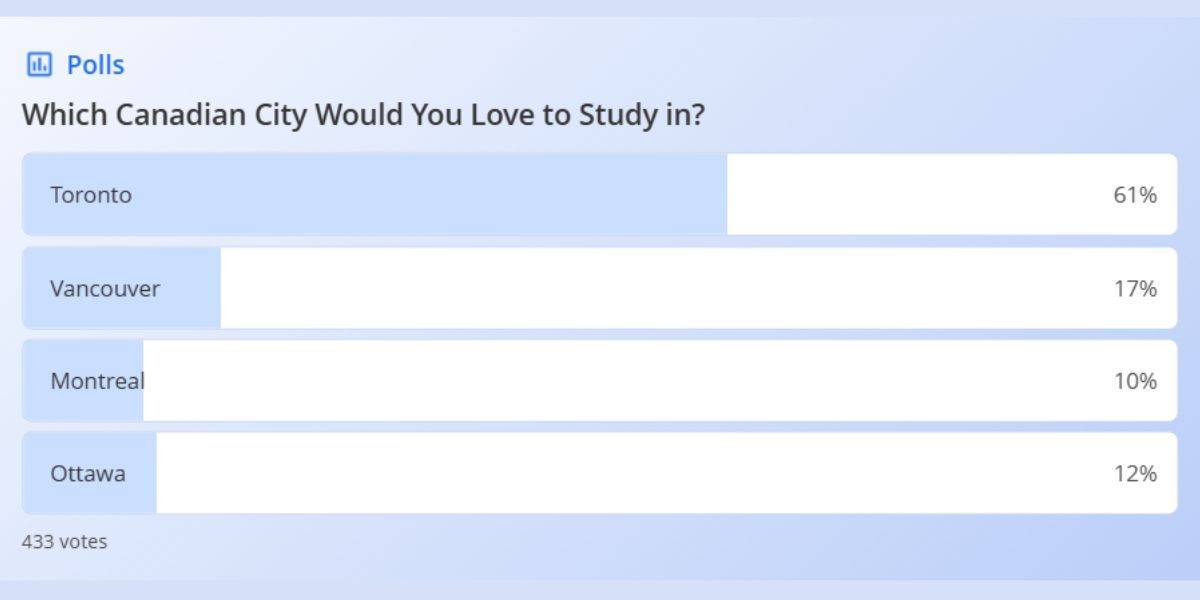
Shiksha recently conducted a poll, where we asked students, "Which Canadian City is the Best for Study?" 61% of the total respondents mentioned that Toronto is their first choice. There are multiple factors behind this decision, such as a popular institute, economic capital, well-developed public infrastructure, and job opportunities. Other than Toronto, students voted for Vancouver, Montreal, and Calgary as well. Here is the detailed poll breakdown:
Study in Canada FAQs
Q. How much does it cost to study in Canada?
A. In 2026, annual tuition ranges from CAD 15,000 to CAD 45,000 (INR 9 to 28 Lakhs). Following new regulations, you must also show CAD 22,895 (INR 14 Lakhs) for living expenses. Total first-year costs typically range between INR 25 and INR 40 Lakhs, depending on your program and city.
Q. Is Canada cheap to study in?
A. While costs have risen, Canada remains 20 to 30% more affordable than USA or Australia. Living in secondary cities like Calgary or Halifax significantly reduces rent. Indian students can offset costs by working 24 hours per week. Though this should only supplement, not replace, your primary education funding.
Q. How can I go to study in Canada for higher studies?
A. First, secure a Letter of Acceptance from a Designated Learning Institution (DLI). For 2026, most students also need a Provincial Attestation Letter (PAL). Apply for a study permit online by providing proof of funds (GIC), academic transcripts, and a strong Statement of Purpose.
Q. What are the top courses to study in Canada?
A. For 2026, the best courses align with labor shortages to ensure PGWP eligibility. Focus on STEM (Software, AI, Data Science), Healthcare (Nursing), Skilled Trades, and Agriculture. Unlike general degrees, these specialized fields are prioritized for Post-Graduation Work Permits and Permanent Residency pathways.
Q. Which are the top universities in Canada?
A. Canada has many top-ranked universities, and here are some of the highest-ranked universities in Canada based on QS ranking 2026:
- McGill University
- University of Toronto
- University of British Columbia
- University of Alberta
- University of Montreal
- McMaster University
- University of Waterloo
- Western University
- University of Calgary
- Queen's University
Please take note that the rankings are subject to change each year and are determined by the methods employed by the ranking organisation. Before making any judgements, it is crucial to do some study and comprehend the intricacies of each ranking. Students who are interested in studying in Canada can visit the websites of these universities to learn more about their programmes.
Q. How can Indian students study in Canada?
A. To study in canadian universities, you need to follow the step by step process mentioned below:
- Select the program and university of your choice.
- Make sure you meet the eligibility criteria for admission.
- Prepare and take the required standardized tests (such as IELTS, TOEFL, or GRE, depending on the program).
- Collect the required documents including LORs and SOP.
- Apply for admission within the university deadline and wait for the offer letter.
- After getting it, pay the application fee and confirm your enrollment.
Q. Is it easy for Indian students to get a scholarship in Canada?
A. Getting a scholarship to study in Canada depends on several factors, such as academic performance and the type of institution. Government organizations, private institutions, and universities offer scholarships to meritorious students based on their profiles. In short, it is not difficult to get a scholarship in Canada if you are an eligible student and apply early.